Monday, May 2, 2011

Ramona's Happy Village


Ramona's Happy Village (2011)
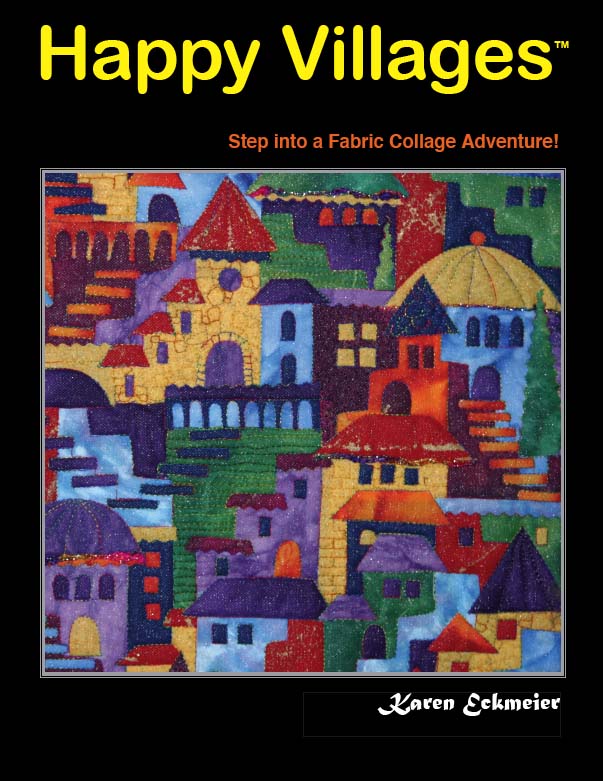
There is something miraculous about turning little bits of nothing into greatness.   That’s my attraction to collage.  Karen Eckmeier author of Happy Villages: Step into a Fabric Collage Adventure! developed a unique process for transforming geometric polygons into a colorful village.   I was drawn to Ms. Eckmeier’s technique due to my desire to create an art quilt resembling an urban city.  I experimented with her techniques to see if they would help to achieve the city developing in my mind.


Ms. Eckmeier’s technique begins by cutting 6 ½” squares of at least 10 different colors into various polygons.   These shapes are then laid randomly on an 16 ½” square of cotton batting with a dot of glue to hold them in place.  At this point, it looks nothing like a city.    But then roofs, windows and stairs  are added on horizontal planes to make the town emerge.  The entire temporarily glued collaged quilt top  is laid over an 18” square of black felt which acts as the quilt back.  However, something is needed to permanently secure all of the little polygons forming the town.   Ms. Eckmeier’s solution is to layer a square of colored tulle over the collage.  Quilting is added alongside the edge of each shape.  This secures the pieces and prevents the cut fabric from fraying.
Random polygons on batting
Village without roofs & windows

Quilted tulle overlay
My finished piece was very quaint.  It reminded me of a town from a childhood fairy tale.   I liked the way the tulle unified the hundreds of pieces. However,  I’m not sure this is the best technique for creating my urban city.    This is an excellent technique when you’re not expecting a specific outcome or an exact image.   It’s perfect for an artist who prefers letting the creation develop as she goes.   It’s not the way to go for the artist who plans and sketches a specific vision.   Also after experiencing the ease of fusing to secure shapes for appliqué,  I didn’t enjoy using tiny drops of glue to temporarily hold each shape.   Using a product like Wonder Under, Heat & Bond, or Misty Fuse instantly secures the pieces while preventing fraying.   Glue is less expensive, but I find fusing more efficient.  
 
Many times expense dictates an artist process, but is there ever a time when efficiency and effectiveness overshadows expense?

Thursday, April 14, 2011

Quilt on Ice

Serendipity 1 (2011), R. D. Lindsey
Mama, why is that quilt on ice?  That’s what my son asked after seeing my latest completed quilt. His question confounded me at first.  Then I realized he was right.  My creation, Serendipity 1, was floating on ice.

Serendipity describes a pleasant result that happens because of an accident.  Lately, I have been intrigued with sheer fabrics.  I wondered how they could be layered to create a sense of depth.  As a child,  I often sat in my mother’s living room watching  the sunlight dance through sheer panels hanging at her windows.  Was there a way for me to create this same sort of light play in an art quilt?  Hence I decided to play with a repurposed curtain,  an old faux suede pillow and synthetic organza.

My exploration started by hand stitching layers of orange, blue, and green organza.  I wanted an organic shape with limited corners and hard edges.  So, I decided to cut away layers of the organza while eliminating the corners.  I was left with a flimsy amoeba.  (I don’t have a love affair with amoeba, but I instantly thought of one after gazing upon my handiwork!)  It needed support.  I grabbed the faux suede pillow fabric and made a mini-quilt sandwich.  The idea was to quilt a circular shape, stitch the amoeba to the quilt, and do some fancy flipping.  The result was supposed to be a sheer amoeba surrounded by an opaque thread painted quilted background.  It didn’t work.  I ended up with a mess. 

Faux suede pieces on rust curtain fabric.

In the spirit of discovery I didn’t give up. I cut the faux suede thread painted quilt from the organza amoeba and tossed it aside.  My next victim was a square of fabric from a recycled rust colored curtain.  I cut a circle in the middle of the square and laid the opening on top of the amoeba.  Now I had the sheer organza surrounded by opaque rust colored fabric.  I stitched everything together, but it lacked interest.  Amazingly, the faux suede mini-quilt bedazzled with orange, blue, and green thread painting yelled from the top of my discard pile, “Hey, use me!”  
  

I cut the mini-quilt into  five organic shapes with lots of curves.   After machine stitching  these on top of the repurposed curtain fabric, I began to see something I liked.  I made a quilt sandwich using more of the curtain material for the back and left over polyester batting from a previous project. I carefully quilted through all layers around the amoeba center and randomly over the opaque surface using blue, green, and orange thread.   After cutting away the backing and batting from behind the amoeba, I realized  the amoeba center wasn’t quite right.  It was too flimsy and lacked some interest.  

Organza covering faux suede piece.
In stepped gel medium and tissue paper.  I turned the piece upside down, used books to elevate the piece,  and watched as gravity pulled the amoeba into a bowl shape.   I attached layers of silver tissue paper to the inside of the amoeba bowl with the gel medium. The gel medium dried and I ended up with a solid translucent amoeba bowl.  When I flipped the work over, I made a horrible discovery.  The gel medium had soaked through some areas of  the opaque curtain and faux suede material leaving permanent discolored areas on the surface.  I didn’t cry.  I just got more creative.  I covered the discolored faux suede by stitching to it the same colors of organza used to make the amoeba center. To my surprise the thread work on the faux suede showed through the organza creating a sense of depth and intrigue.

Organic shape defined by stitched border.
Finally, I defined my works organic shape with a machine stitched border of thread.  I trimmed  away the fabric beyond the stitched border to further  define the organic  shape.  Inspired by Quilting Arts Magazine’s publication, “How to Bind a Quilt: 12 New Quilt Binding and Finishing Methods for Your Art Quilts”,  I burned with a heat tool all the edges of the synthetic curtain fabric and organza to prevent fraying.  My finishing touch was to paint the edges with fabric paint like I saw Darcy Berg do to finish some of her quilts.  I used beads from an old tangled necklace to give the amoeba a nucleus and food vacuoles.  I held up my finished piece for a better look.  What I saw was pretty nice, but the light dancing through the amoeba center was even more amazing. 

Candle on glass block
How could I display this small experiment so light could shine through the center? I remembered reading Lyric Montgomery Kinard’s  instructions for mounting works on Plexiglas.  I mounted the piece on Plexiglas and purchased an 8” x 8” glass block from a big-chain hardware store.  Using Loctite Super Glue, I attached the Plexiglas to the glass block, which happens to look like a block of ice. Since the block was so larger and fire resistant,  I could safely place a lit candle inside a glass votive behind the amoeba art quilt.  Thanks to serendipity, I now have an entry for a science inspired exhibit. (I really don’t love amoeba, but Serendipity 1 certainly reminds me of one.)
Sometimes a series of mistakes can really result in something good.  What mistakes have you made in your work that resulted in something good?

Monday, January 31, 2011

The Great Do Over!

I often enjoy listening to talk radio while I'm driving.  This is a habitat my husband helped me develop.   While running errands over the weekend, I heard a show on NPR.  I'm not sure of the broadcast's name, but the host led the show with a very interesting question -  "Have you ever driven through a small, remote town and wondered what it would be like to stop your car, stay awhile, and start your life over?"  No one would know you or your past.  It would be the ultimate do-over.  As I listened, I realized I was at this exact place in my life.  With one difference, I left the small town for the big city to get my do-over.
All My Energy (2010) - Front
I am a very spiritual person - not religious.  For the majority of my time on Earth, I have lived as a Christian who tries her best to follow the word God.  I have never been caught up in denominations but instead the scriptures.  As I later reflected on the radio show,  I thought about a scripture.  It says ,"Don't copy the behavior and customs of this world, but let God transform you into a new person by changing the way you think.  Then you will learn to know God's will for you, which is good and pleasing and perfect. (Romans 12:2, NLT)"  For several years, I have tried to fulfill the expectations of the world through my career.   I've done what I thought people expected of me or what was safe or practical. 
God moved me out of my comfort zone when He relocated my family to Chicago and took my job.  At first, I resented the move and unemployment.  Slowly, my thinking began to change and both situations became an opportunity for a new beginning.  God had placed me in an environment where the artistic gifts He gave me could be nurtured.   Over the past year He has allowed me to use art to give voice to young people and myself.   I never thought the creations from my hands could impact the lives of others.  But there is a scripture that counters my limiting thoughts.  It says, "Now unto him that is able to do exceedingly abundantly above all that we ask or think, according to the power that worketh in us. (Ephesians 3:20, KJV)."
All My Energy (2010) - Back
All My Energy - A Metaphoric Self Sculpture (2010), one of my recent fabric sculptures, symbolizes my transformation in thinking.  The butterfly, with its warm colors, represents my emergence from a cocoon of doubt, pressure, and stress with the energy to accomplish new heights.   A butterfly thrives in a garden with grasses for shelter and flowers for nectar.  The grasses in this piece represent opportunity while the flower symbolizes abundance.   But the opportunities and abundance are above the butterfly.  The butterfly has not yet begun to put into motion its potential for flight, which will eventually carry it beyond the grasses and flowers.  This is where I  am in my journey as an artist.  I'm just beginning to stretch my wings.  But with the power that works within me, I  know my art will carry my spirit to new heights.

Monday, January 24, 2011

Artists Mean Business


Sharing Our Water, Kiela Upton-Smith & Nina Smoot-Cain
The more I learn about the history of the creative industry and the life of an artist,  I have discovered most artists don't see themselves as entrepreneurs.  This must change if artists are truly to gain control of how their creativity is viewed by the larger population.   There is a huge movement among certain groups in the African-American community to promote art collection.   This is a consistent topic on Black Art in America.  The Artisan Series, sponsored by Rush Philanthropic Arts Foundation and Bombay Sapphire, attempts to provide exposure to urban artists and photographers. As collectors and philanthropists continue to recognize art as viable investments, it is important that artists gain the proper recognition and compensation for their work.   Artists must mean business. 

How do artists make the transition from a mere creative force to a business mogul?  One step is to attend the Artists Mean Business Workshop.  The focus of this workshop is to address the artist's needs as a creative professional.  This professional practices and community building workshop is for artists working in Chicagoland, the Industrial Corridor, or Chicago's Creative Industry District.  Artists attending this free workshop will discuss gaining access to low-cost marketing options, protecting your art, and healthy habits for working artists.  Songhay Studios Group, the Institute for Arts Entrepreneurs and Ozinga are the official sponsors of this event.   If you are serious about the business of your art, you must attend this event.

Date:                    Sunday, January 30, 2011

Time:                    3:00 - 4:30 pm

Where:                 Songhay Studios Group
                            629 W. Cermak #205
                            (Enter off Ford Street)

Cost:                     Totally Free

Friday, January 14, 2011

Laurie Swim: Lasting Memorials

End of Day (2002), Laurie Swim
SOFA 2010 (International Sculpture Objects and Functional Art Fair 2010) in Chicago, Illinois, featured an art quilter who helped re-ignite my interest in art quilts.   While searching the internet for a local quilt artist, Gwen McGee Boyd, who is now my mentor, I discovered the work of Laurie Swim.   Ms. Swim is a veteran art quilter who currently resides in Nova Scotia, Canada.   She has created art quilts for over 35 years.   Her creations use various fabrics and threads giving her work texture and movement.

Dory Idyll (2006), Laurie Swim

As a young quilter, I was taught cotton fabrics were the preferred cloth for quilting.   Laurie dismissed this traditional use of cotton.  Her work often incorporates silks, linens, and sheers which add interest and  the illusion of movement.   Before attending SOFA, my only experience with Ms. Swim's work was through books and the internet.  SOFA gave me the opportunity to come within inches of her creations to fully appreciate her raw edge appliqué technique and intricate quilting.  Her work was even more impressive in person.  

Laurie Swim is not only known for awe-inspiring art quilts, but for her work developing large scale community quilt projects.   She uses her art to give voice to communities struggling with social and economic issues.   Working with communities she raises awareness and  provides memorials with art quilts.   "Lost at Sea", pays tribute to 17 Novia Scotia fisherman who drowned in a terrible storm.  Another tribute raises awareness for improved safety laws for young people between the ages of 15 - 24 who were killed or injured while  working in Canada.  "The Life Quilt" is a memorial for thousands of young people linked by the fact that their tragedies didn't have to happen.  Her most recent community quilt was unveiled in March 2010.  "Breaking Ground:  The Hogs Hollow Disaster 1960" honors 5 Italian immigrant workers killed in a 1960 accident while digging a  new water main line in northern Toronto.  This  7' x 20' tribute was  created by dozens of volunteers stitching for  thousands of hours  over a 9 month period.   
Breaking Ground (2010), Laurie Swim
Laurie Swim's art provides more than beauty.  It amplifies voices of communities. How is your art raising awareness and remembering the sacrifices of others?

Monday, January 10, 2011

Marilyn Pappas: Imperfect Beauty in Perfected Stitches

Last November,  I volunteered at SOFA 2010 (International Sculpture Objects and Functional Art Fair 2010) in Chicago, Illinois.  SOFA is one of the world's premier fairs for contemporary  decorative arts and design.   Collectors from all over the world visit SOFA each year in search of the best in contemporary art.   The aisles of SOFA overflowed with glass, wood, and metal sculptures.  However the hard lines of these mediums were softened with various offerings from fiber artists.  As a fiber arts enthusiasts, I was disappointed by the small number of fiber artists represented at SOFA.  But as a fiber artist, I realized the huge market potential for an artist willing to press the limitless possibilities of fiber.  In this week's posts, I will highlight some fiber artists featured at SOFA 2010.
Nike with Broken Wing (2006), Marilyn Pappas
Marilyn Pappas is a fiber artist who began her career in 1960.   Her hand stitched drawings on linen focus on the imperfection of beauty.   The labor intensive and meticulous stitches seem to float above the fabric.   Her work was filled with an airiness which pulled me at my emotions.  I felt both sadness and respect for beauty that was once awe-inspiring but waned over time.  It reminded me that our whole selves will one day be forgotten.  However, pieces of us will be forever immortalized in the memories of those who remain.
Ms. Pappas's intricate stitch work fascinated me.   I am learning  to use thread to "paint" the details and contours of my fabric pieces.  Ms. Pappas has perfected this technique.  Her  thread color choices, wide-ranging stitch lengths, and varied stitch density effectively gave her work dimension.   Her choice of fine sheer linen as the  foundation for her pieces provided an airiness which unexpectedly supported the weightiness of her stitches.  
Ms. Pappas declares in one of her artist statements that "…I choose to express my ideas in a direct but labor-intensive way, grateful for the comfort and pleasure that comes from handwork, developed slowly over time.  In this high speed world I rejoice in the meditative process of the work…."   I am also fond of the relaxing nature of hand stitching.  In this age of technology generated art, I was refreshed by an artist who embraced the beauty and soulful benefits of traditional techniques.  How are you using time-honored strategies to embrace beauty and nurture the soul?

Thursday, January 6, 2011

Money for Your Voice


Cover Art - CAAP Booklet, Annie Heckman
Finding your voice is a great way to begin 2011.   Individual artists often need financial assistance to help with the process of realizing their voice.   Thanks to my friends at Artistically Linked I attended an information session that showed where we can get help.  The City of Chicago Department of Cultural Affairs is offering dollars to support new, emerging, and mid-career Chicago artists.   The 2011 Community Arts Assistance Program (CAAP) is now accepting applications from individual artists and not for profit organizations for Cultural Grants.  

If you are an individual artist in any discipline needing up to $1,000 to complete a project, purchase supplies, attend professional development, or travel out-of-state, then you need an application.   Applications can be found at the City of Chicago website on the Community Arts Assistance Program page.    Act quickly so you can meet the January 31st, 2011 deadline. There are still 2 opportunities for you to attend an information session that will assist you in writing a competitive request.  These dates are on the site.

Where Two or More, Trish Williams
Each request will be reviewed by a panel of artists representing various disciplines.   According to Meg Duguid, the information session presenter, this process is intended to bring together the Chicago artist community to promote and support artist development.   In an effort to make sure that artist's voices are heard, the Department of Cultural Affairs is asking applicants to nominate panel representatives. I am committed to improving the recognition of all fiber arts.  Can you send me names of Chicago  fabric, quilt, textile, or surface design artists who can represent the  voice of visual artists who embrace fiber in all  forms as members of the CAAP review panel?