Friday, May 13, 2011

How Am I Doing?


Embrace (2011) Art quilt with mixed-media collage
Embrace(2011) is my latest creation as a professional mixed media artist. It is a collaboration of my favorite mediums and techniques - collage, fabric, and sculpture.   I enjoy combining small bits of this and that to create something new and exciting.   Collage and quilting do just that.   As a youth, I enjoyed giving family and friends unique gifts from my heart and hands.  I always had little money for art supplies, but my mother was an elementary school teacher who always had construction paper, crayons, and glue.  I would raid her stash of old magazines, kitchen cabinets, and jewelry drawers for things I could use in my art creations.  These early exploits began my foray into the world of collage.  

Soft Sculpture saxophone detail
My mother was also an amateur seamstress.  She never let me on her sewing machine, but she gave me needle, thread, and fabric scraps.   I loved the feel of the needle passing through the fabric.  Working with the needle and thread was calming.  It allowed my mind to escape the cares of the world.  As I grew, I realized making clothes was not my thing.  Instead, I'd rather use fabric to create beauty I could hang on walls for all to see.  


Bas Relief Singer detail
After watching, Ghost, starring Patrick Swayze, Demi Moore, and Whoopi Goldberg, I convinced my mother to buy me a mini-pottery wheel.  I never mastered that thing.  Even after taking classes, I really disliked throwing clay.  But someone suggested I try hand building.  Now, that was my speed.  I appreciated the feel of the clay and my ability to mold it into something special.  However working with clay is expensive.  So I reached back into my fabric stash and began experimenting with fabric sculpture.

Hand stitched ribbon detail
Embrace(2011) marks more than the beginning of a spirit led art career. It signifies the merging of all of my artistic passions into one piece. I randomly cut warm colored fabric shapes from repurposed clothes and curtains.  I used fabric fusing techniques to collage these pieces to create a vibrant art quilt focal point.   Then I used fabric sculpture techniques to mold a 3-D saxophone and bas relief singer.   The gold ribbons leaping from the instrument were hand stitched to the art quilt symbolizing music's embrace over every aspect of a community.  Next, I collaged a stretched canvas with layers of sheet music containing old jazz standards, acrylic paint, tulle, and gel medium.  I'm inspired by language and the sheet music represents the language of music.  Finally, I hand stitched the art quilt to the sheet music to complete the story.
 
Screen-printed homes detail
I am a self-taught artist transforming a creative hobby into a professional career. Many artists believe extraordinary art is determined by a work's design composition (balance, proportion, rhythm, emphasis, unity) and artistic elements (line, shape, form, space, color, value, texture).  As creative individuals, we can grow from each other's feedback.   How well do you think Embrace addresses design composition and artistic elements?  I would love to read your honest and informed comments to further my development as an artist.

Monday, May 9, 2011

Slave to Markets vs. Free to Create


Embrace (2011), R. D. Lindsey
We often become slaves because we decide to let outside forces dictate the direction for our lives instead of allowing a well-fed spirit to guide us.  At the start of my professional journey as an artist, I decided the art market and collector’s tastes would influence my creations.  I thought, “This is the best strategy for success!  If no one wants your work, how else can you make money?”  After visiting several art exhibits, I noticed that many African-American artists used music as their primary subject.   I wanted to set myself apart, so I refused to create any work dealing with music.  What a series of stupid decisions!

Over the past several months, I have exposed myself to true artists - artists who see their work as a spiritual connection with the world’s inhabitants.  True artists base their success on more than dollars gained from sales.  Success is based on their ability to touch hearts, souls, and minds.  Their work is the deepest form of human sharing.  I have learned my creative expression is a gift from God.  He has given me a story to tell through my hands’ creations.  Now,  I need to tell the story of resiliency.  I am a black artist who must not be ashamed to embrace my heritage and resiliency.   

Fabric sculpted saxophone
Why do so many African-American artist use music as a subject? Because it is so much a part of our people.  Music embraces every part of our being.  On Sunday morning’s it ushers in our worship.  Saturday evenings it cosigns our stories around the card table.  Melodies from living room concerts float out windows to entertain the entire neighborhood.   Music sets the mood for lip locking passion. And regardless of our economic condition, many of us lace our music with a little libation to lift our spirit and dull our pain.  But if we want to really be honest, music does this for every inhabitant of God’s Earth.  Music is a universal embrace.
 
I have struggled for months to create an image that represents me as an artist.  Nothing seemed to fit until an acquaintance approached me about a commission representing her family’s passion for music.  I started playing around with ideas and felt my spirit soar as I worked on a practice piece.  Since then the commission has died but my spirit has resurrected with the creation of my latest piece, Embrace.  Embrace marks the beginning of a spirit led art career.  With this new beginning, comes  my declaration of  freedom to embrace God’s purpose for my life as an artist.  My way is not crystal clear, but I’m daring to depend on the power of my well feed spirit to light the way.

Wednesday, May 4, 2011

I Can Play, Too!


Mono-print on cotton with ProChemical Inks
Children have the most unusual ideas about appropriate activities for their parents. Our children always have busy weekends.  Last weekend, as a gesture of feinted concern, my son asked, "What are you doing today?" 

I proudly responded, "I have a play date."
He scrunched his nose, bucked his eyes, and with raised brows declared, "You are too old for a play date!"

Every artist should make time to play with their friends.  You may wonder what is an artist's "play date".  It is an opportunity for like minded artists to come together to share ideas, techniques, and processes.   A play date is an opportunity to explore possibilities with the support of others who aren't afraid to try something new.   It is an chance to expand your artistic process.

Play dates are especially important in a depressed economy.  When an artist is having difficulty selling their work funds are limited for intensive workshops and professional development.  Without these opportunities, an artist runs the risk of becoming stagnant.  Play dates allow the artist to learn from other artists working in the same media.

Mono-print on cotton with Setacolor paints
How does a play date work?  It's very simple.  You get together some friends. Bring some toys to their studio. And after playing for hours you eat together.   In my case, my friends were 5 members of Professional Art Quilters Alliance (PAQA), which is based in Illinois.  We decided before hand to play with mono-printing on fabric.  So our toys were inks, paints, fabrics, and tools from our personal stashes. During my younger play dates, we always tired of the game we came to play and thought of something new to do.  This is also the case today.  We soon tired of mono-printing and began exploring stamping.  Finally, the youngest member of the group anxiously announced, "I have an hour before I have to pick-up my kids!"

That was the signal for the best part of the play date - LUNCH!  Each person brought something to share.  Like most health conscious artists we had a balanced lunch of fresh, organic salad made with lettuce from our hostess's garden accompanied with homemade bread and followed by three different decadent desserts. (OK, you're right! The meal wasn't really balanced.)  But it allowed us to ruminate about life the way only a bunch of creative ladies know how.

I hope you are in no way like my son.  Don't ever think you are too old to play!  I know I can't wait until our next  4 hours of artistic fun. Who are you going to call to schedule a  play date? 

Monday, May 2, 2011

Ramona's Happy Village


Ramona's Happy Village (2011)
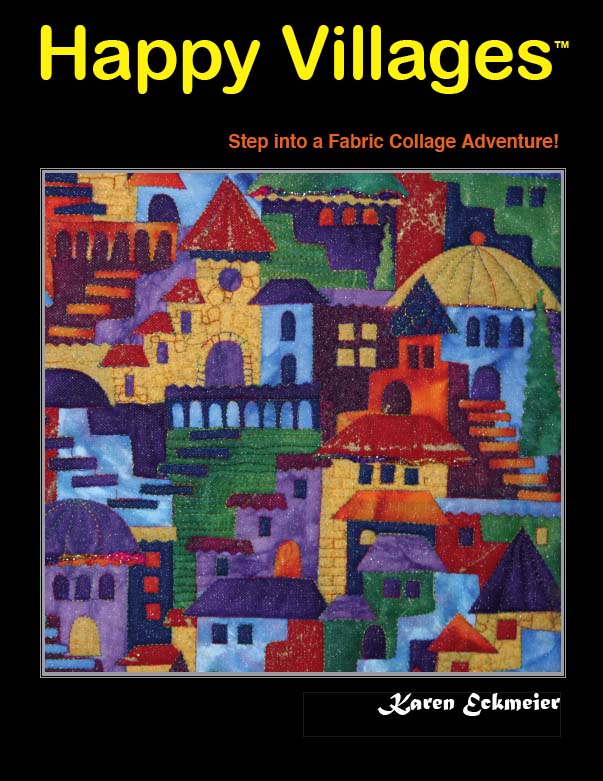
There is something miraculous about turning little bits of nothing into greatness.   That’s my attraction to collage.  Karen Eckmeier author of Happy Villages: Step into a Fabric Collage Adventure! developed a unique process for transforming geometric polygons into a colorful village.   I was drawn to Ms. Eckmeier’s technique due to my desire to create an art quilt resembling an urban city.  I experimented with her techniques to see if they would help to achieve the city developing in my mind.


Ms. Eckmeier’s technique begins by cutting 6 ½” squares of at least 10 different colors into various polygons.   These shapes are then laid randomly on an 16 ½” square of cotton batting with a dot of glue to hold them in place.  At this point, it looks nothing like a city.    But then roofs, windows and stairs  are added on horizontal planes to make the town emerge.  The entire temporarily glued collaged quilt top  is laid over an 18” square of black felt which acts as the quilt back.  However, something is needed to permanently secure all of the little polygons forming the town.   Ms. Eckmeier’s solution is to layer a square of colored tulle over the collage.  Quilting is added alongside the edge of each shape.  This secures the pieces and prevents the cut fabric from fraying.
Random polygons on batting
Village without roofs & windows

Quilted tulle overlay
My finished piece was very quaint.  It reminded me of a town from a childhood fairy tale.   I liked the way the tulle unified the hundreds of pieces. However,  I’m not sure this is the best technique for creating my urban city.    This is an excellent technique when you’re not expecting a specific outcome or an exact image.   It’s perfect for an artist who prefers letting the creation develop as she goes.   It’s not the way to go for the artist who plans and sketches a specific vision.   Also after experiencing the ease of fusing to secure shapes for appliqué,  I didn’t enjoy using tiny drops of glue to temporarily hold each shape.   Using a product like Wonder Under, Heat & Bond, or Misty Fuse instantly secures the pieces while preventing fraying.   Glue is less expensive, but I find fusing more efficient.  
 
Many times expense dictates an artist process, but is there ever a time when efficiency and effectiveness overshadows expense?